


An informed public can take meaningful action by advocating for change, voting for change - either at the ballot box, with their wallets, or by raising their voices to demand it - as well as by implementing changes in their own backyards and communities.
STORYTELLING FROM THE FRONTLINES
To help inform, educate, inspire and empower the public to become better guardians of the global commons, Earth HQ continues to work closely with Mongabay. This year we launched a “Forest Indigenous & Local Community Investigative Reporting’ project, dedicated to reporting on forest ecosystem destruction and the role Indigenous Peoples and local communities (IPLCs) play in achieving conservation outcomes. Earth HQ and Mongabay also funded and staffed the first Indigenous Reporting Desk, supporting investigative reporting by indigenous reporters. A link to Earth HQ funded investigative stories is here.
Mongabay stories from the frontlines feature prominently on our interactive dashboard, which also draws on real time satellite and other data to keep people up to date on the latest extreme weather events and what these mean for people’s lives and livelihoods.
We’re proud that our partnership with Mongabay helps them leverage over 800 correspondents in around 70 countries, mostly in the Global South, dedicated to evidence-driven environmental and social science journalism, to bring the stories of change into the news feeds of people everywhere. This has given a voice to young professionals on social and environmental issues in indigenous territories that otherwise would not have had an amplifying platform. In turn this enables the Global Commons Alliance to enrich our offerings to the public.
800+
Correspondents
70
Countries
140
Stories
4 million
Monthly readers on Mongabay
Building on this core aspect of our communications, we’ve made progress over the past few months toward the September release of a new, state-of-the-art Planetary Health Check portal, in partnership with the Planetary Guardians, the Potsdam Institute for Climate Impact Research (PIK) and other key partners. This will help inform the public and decision makers to inform policy design.
HARNESSING THE POWER OF MEDIA AND MARKETING
Through Earth HQ, we’ve also taken the first steps towards launching a new initiative which brings together science and creativity to reimagine and rework how we communicate about the Planetary Emergency. This initiative – the Earth Public Information Collaborative (EPIC) – aims to inform one billion people about the state of the planet and move them to demand action.
The EPIC Leadership Council has been convened, a group of powerful and diverse communication thought leaders and funders to advise EPIC. EPIC’s communications research hub was launched: A New Era in Climate Communications, which is a collaborative effort spanning +60 contributors and organizations to lay the foundation for a transformed future through the power of communication and creativity. Soft launches to socialize the EPIC concept were held at Cannes Lions Festival in June and the TED Countdown in July, and in September 2023 during Climate Week NYC and the UN General Assembly.
UNDERSTANDING THE PUBLIC’S ATTITUDES TO CHANGE
A key part of our engagement with the public includes not only informing and empowering them but also learning from them too. Over the past few months we’ve worked in close partnership with IPSOS Mori, Earth4All, the Policy Institute King’s College, the Wellbeing Alliance, ISWE and the Wellbeing Economy Alliance to survey the G20+ on their attitudes towards the global commons and to political and economic transformation.
The findings show that there is strong support for urgent action, and for wellbeing economies across the G20. Sixty eight percent agree that the way the economy works should prioritize the health and wellbeing of people and nature rather than focusing solely on profit and increasing wealth (only 8% disagreed).
The majority of people in the G20 understand the urgency of major action to protect nature and the environment.
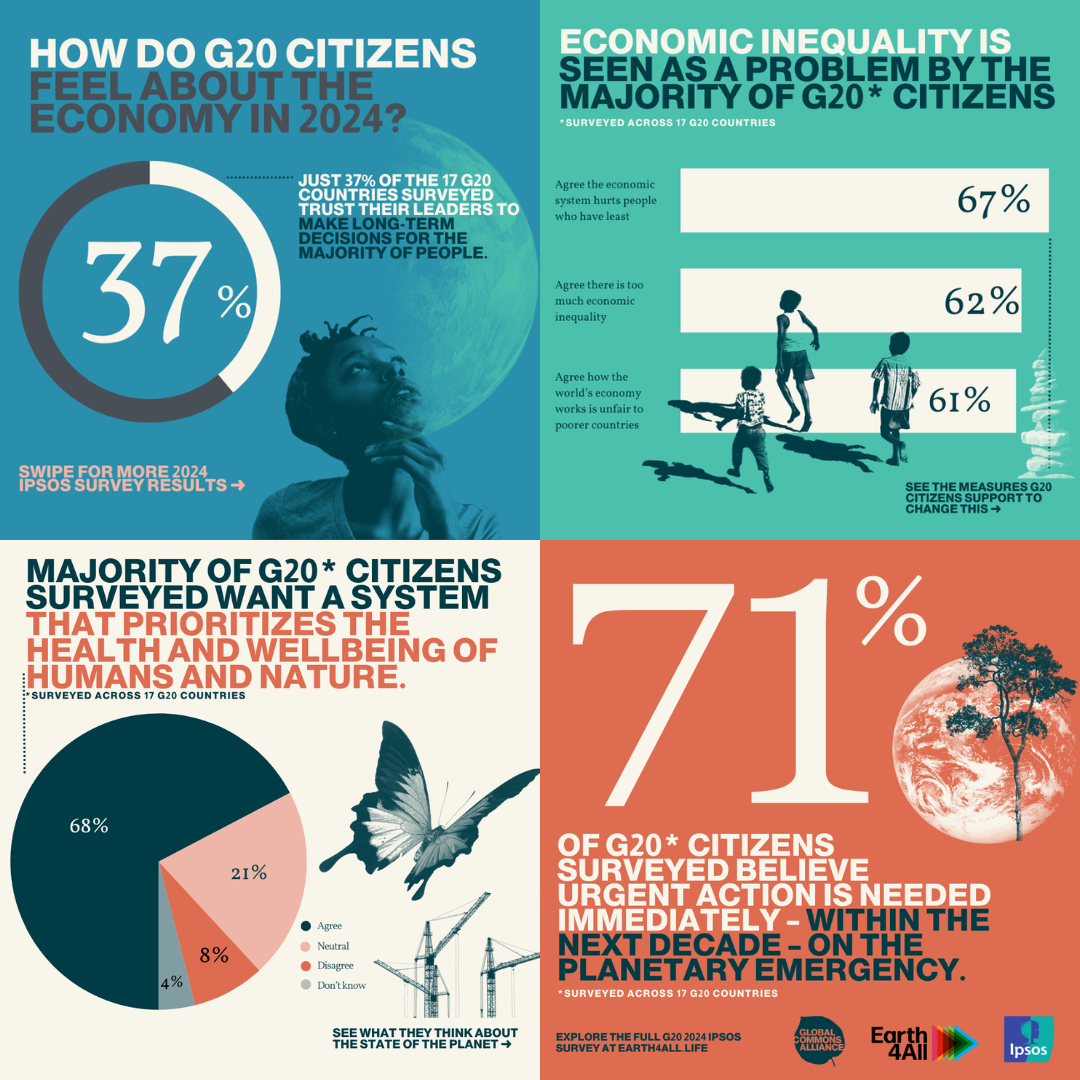
Social media graphics showing key findings of the 2024 Earth for All G20 survey
These findings, the first set of which was released on 24 June, 2024, will be used to inform policy makers, civil society groups and other decision makers over the coming months, including in the lead up to the September Summit of the Future.




Incentivizing
economic actorsOur economic systems have exploited the global commons bringing them to breaking point. We need to radically transform these economic systems, which reward short term profits from commodity production based on unsustainable practices that deplete natural capital.