



The Earth Commission delivers a regular synthesis of the best available science, providing a guiding star and a measure of progress for the Global Commons Alliance.
Here are some of the highlights:
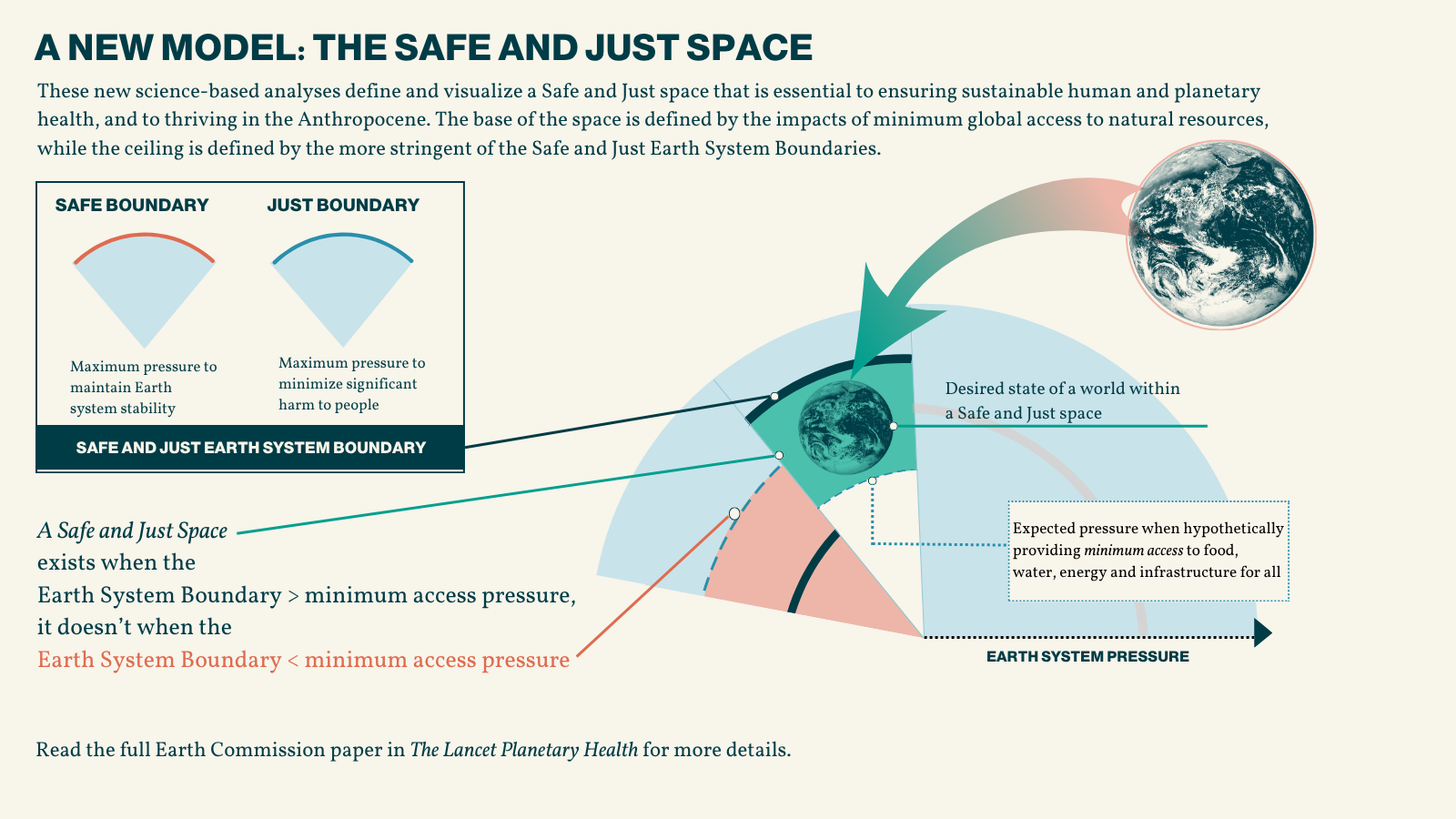
- In September 2024, the Earth Commission published a keystone paper on the Safe and Just Boundaries, which quantified the ‘Safe and Just Space’ for humanity on planet Earth. This was the first time scientists had quantified safety (a stable planet) and justice (people being protected from harm and ensured a life free from poverty) in the same units — demonstrating that justice is a prerequisite for the safety of both the planet and its people. This pioneering research shows that, through just transformations, it is possible for all humans to escape poverty and be safe from harm caused by Earth system change.
- The paper — A Just World on a Safe Planet — identifies the fundamental just transformations that would allow societies, businesses and economies to thrive without destabilizing the planet. The research shows that we need to reduce inequalities in how critical Earth system resources, like freshwater and nutrients, are accessed and used. It also describes the need for economic and technological transformations. The findings were summarized in an explainer brief, an accessible video and impactful visualisations.
This pioneering science, generated by over 60 natural and social scientists from all over the world, many of them leaders in their fields, should be informing agendas for all decision makers. The Global Commons Alliance is dedicated to helping an ever wider group of civil society, government and economic actors understand its significance and application in international governance and the real economy.
The launch generated nearly 200 stories in the media worldwide, including in top-tier outlets Financial Times, The Guardian, and Bloomberg. A blog post was published by World Economic Forum. The launch was supported by a strategic social media campaign with 3.1 million impressions. The Altmetric score was in the top 5% of all research ever tracked.
3.1 million
Media impressions
5%
The top 5% Altmetric score of all research ever tracked
200+
Media stories worldwide
External recognition and awards
- In recognition of his outstanding work in climate science and modelling, Earth Commissioner Prof. Detlef Van Vuuren, won the prestigious 2024 NWO Spinoza Prize. Van Vuuren, who is co-leading the Commission’s Transformation Pathways workstream, will use the 1.5 million euros prize to further develop scenarios to help us reach our envisioned future of a just world on a safe planet.
- Two Earth Commissioners — Prof. Joyeeta Gupta and Prof. Keywan Riahi — were also recognized for their contributions, and appointed by the UN Secretary General to the UN 10-member group: an advisory panel on science, technology, and innovation for the SDGs, helping to put Safe and Just science on the global agenda.
- Varsha Vijay of the Science Based Targets Network, which is aligned with Earth Commission science, was recognized for her excellence in translating the science for business and investor relevance by being announced as a member of the Nature Action 100’s first Science Council.
- We celebrated the women in the Earth Commission as part of International Day of Women and Girls in Science with a celebratory piece recognizing their extraordinary contributions to advancing the Safe and Just science. This piece was one of our most popular across social media.
Translating the Safe and Just Science for different audiences
We worked hard to make sure the Safe and Just science was understandable and applicable to many different audiences including:
For the broader academic & scientific community
- Together with the World Climate Research Project, AIMES and Future Earth, the Earth Commission organized several webinars on tipping points — like the potential collapse of ocean currents — in natural and social systems.
- Since 2021, the Commission has published over 20 peer-reviewed scientific papers, many in top-tier journals, actively shaping discussions within the scientific community. In total, the papers have been cited more than 4,500 times, reflecting our wide-reaching impact and influence across academia. The last year’s publications include:
- an article on city-company collaboration in Nature Sustainability, outlining how cities and companies can work together to contribute to a sustainable world,
- a paper on how the just boundaries were defined.
- and one on tipping points in oceans and monsoon patterns.
- Additional papers, include this one from a team of authors including Johan Rockström on how the planetary boundaries can guide humanity’s future on Earth.
20
Peer-reviewed scientific papers in top-tier journals
4,500
Times the papers have been cited
Translating the science for Civil society and CSO leaders:
- During the COP16 Biodiversity talks in Colombia, the Earth Commission explored the applicability of the Safe and Just Boundaries in the Latin American region and beyond with scientists and Indigenous Peoples groups. Attendees discussed how this science can be integrated into policy to support the implementation of the Global Biodiversity Framework — as well as how Indigenous leaders are also influencing scientific research.
- At Villars Institute Symposium in March 2025 the Earth Commission’s science was top of the bill at the Global Commons Alliance workshop, where a range of leaders from across the civil society space discussed ways to advance systems change.
- The Earth system science and definition of Safe and Just boundaries has also provided the guidance for the evolution of the Global Commons Alliance.
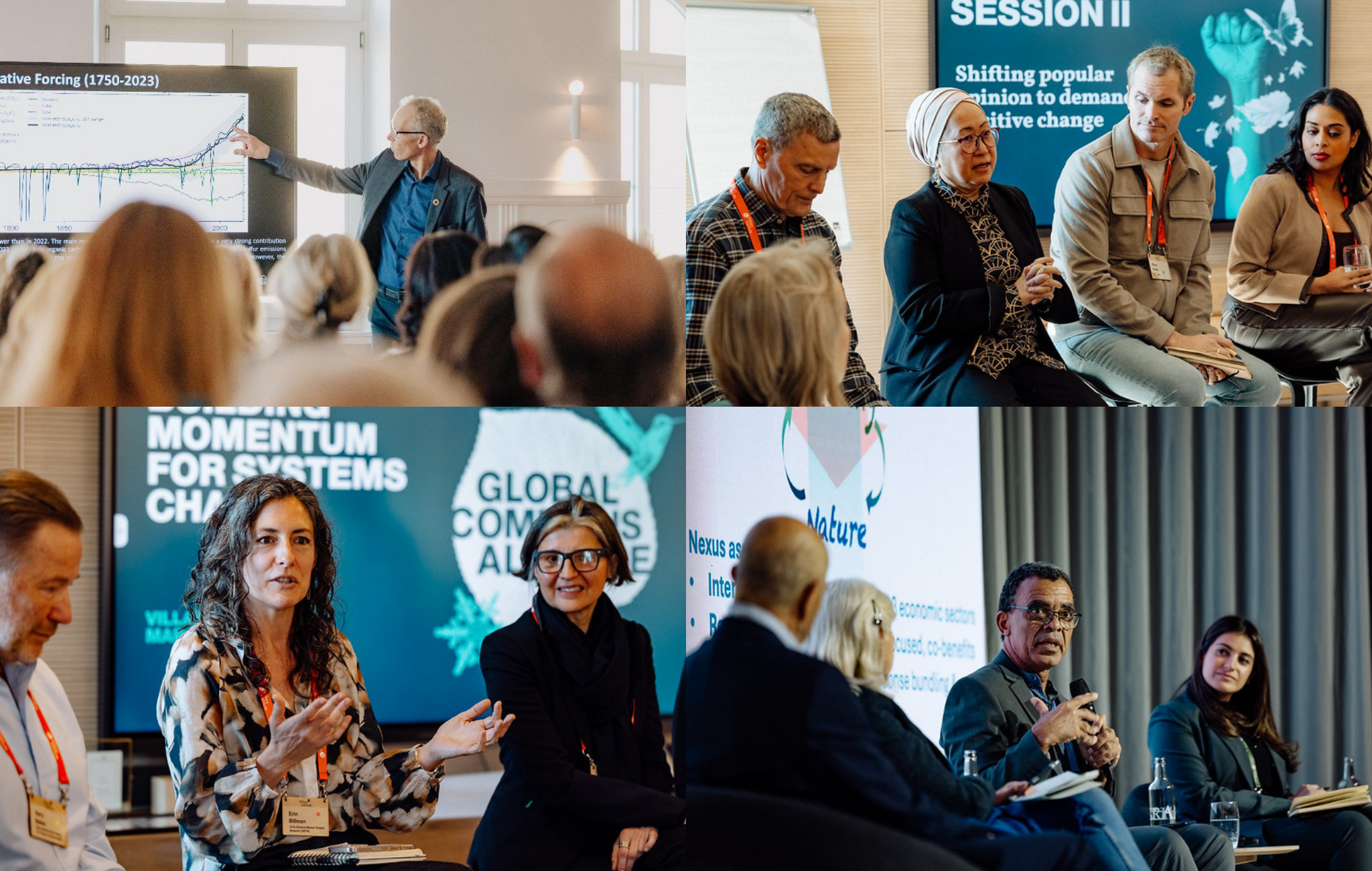
Global Commons Alliance at Villars Institute Symposium 2025
Translating the science for Cities and local governments
- In June 2024, the Earth Commission presented at the Sustainability, Research and Innovation Congress, co-convened by Future Earth and the Belmont Forum with local co-organizers in Finland. The event focused on how to translate the Safe and Just science into action by cities, with participation from the City of Copenhagen and Helsinki.
- Later in the year, the Earth Commission published new research which showed that aligning climate targets between major co-located cities and businesses could amplify emissions reductions by 67%, driving significant progress toward sustainability.
110
cities with net-zero targets and 22 companies with science-based targets are on track to reduce 3.41 gigatons of CO2 of annual emissions.
67%
Is the amount that emissions could be reduced by aligning climate targets between major co-located cities and businesses.
- Systems Change Lab complemented the scientific offerings with a webinar on the current state of our cities and the built environment as well as what systemic action is needed in this critical decade. This event incorporated the key aspects of justice that form part of the Earth Commission’s studies — in this case looking at how city planners can ensure equity and access to basic needs like housing, transportation, energy, water and sanitation, food, green space and more.
- During the COP16 Biodiversity talks in Colombia, we attended the Urban-Nature Programme Mayors’ Leadership Forum, in which several city mayors as well as development banks highlighted the need to bring nature more centrally into city economic development — underlining the relevance of the GCA’s plans with a group of Nordic cities, to understand what it means for cities to operate within the Safe and Just Boundaries.
- Advancing the science-based targets scope to include cities for the first time, the Science Based Targets Network (SBTN) cities program launched in May, with webinars and in-person workshops in Berlin. This was followed by an event at COP16 where the SBTN explored how cities can translate global biodiversity goals into actionable local targets, to ensure they contribute effectively to biodiversity conservation and restoration.
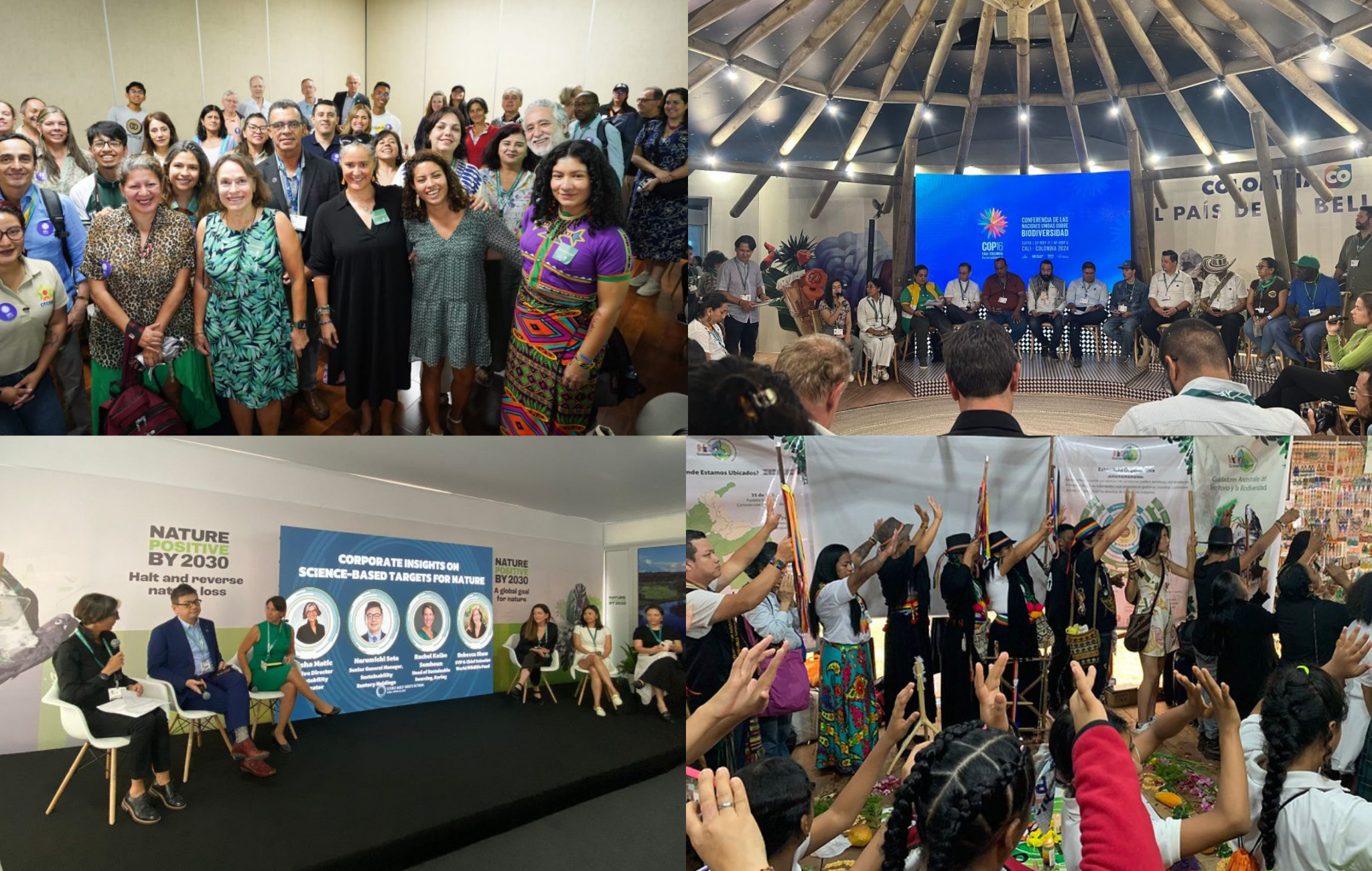
Events the Global Commons Alliance hosted or joined at COP16
Translating the science for nation states and the multilateral system
- After A Just World on a Safe Planet was published in the Lancet, the Earth Commission co-hosted a high-level roundtable to address the links between planetary stability, inequality, justice and human well-being during Climate Week NYC. This was particularly poignant as it was during this week that world leaders adopted a Pact for the Future. The Pact is designed to turbocharge the Sustainable Development Goals and the Paris Agreement, accelerating a just transition away from fossil fuels, and securing a peaceful and livable future for everyone on our planet.
- Also during Climate Week NYC 2024, the Planetary Health Check report was launched. With a web portal built and hosted by EarthHQ, the Potsdam Institute for Climate Impact Research (PIK) and the Planetary Guardians, this first-of-its-kind scientific tool reports on the health of the Earth’s vital systems. Its overall diagnostic shows the ‘patient’ — Planet Earth — is in a critical condition. The Planetary Health Check represents a crucial step in collective efforts to understand and protect the stability and resilience of our shared planet. Reports with updates on the state of the planet will be published annually, because timely updates on Earth’s health are so important. These updates will show how different Earth system boundaries react with each other, and show how close we are coming to Earth-system tipping points.
- In February 2025, during a seminar hosted by CDP Japan and the Japanese Ministry of the Environment about water disclosure and target-setting, beverage company Suntory Holdings shared how it is implementing science-based targets methods, alongside collaborator Kumamoto Groundwater Institute. The Ministry also revised its guide on sustainability disclosure for Japanese companies, to incorporate nature-related scenario analysis based on Taskforce on Nature-related Financial Disclosures (TNFD) recommendations, and referring to the SBTN’s science-based targets for nature on target-setting.
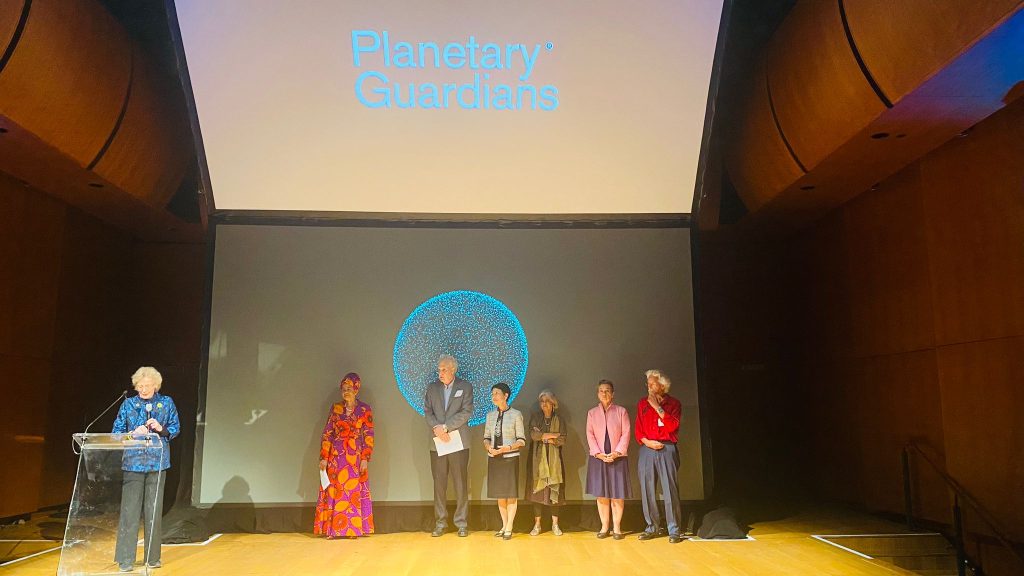
The Planetary Guardians launching the Planetary Health Check at Climate Week NYC 2024
Translating the science for Business leaders
The Science Based Targets Network (SBTN) helps align the Safe and Just Boundaries defined by the Earth Commission into actionable targets for businesses and cities. This translation provides a practical framework and guidance for organizations to set science-based targets for nature, helping them operate within the Earth’s biophysical limits to contribute to a stable and just planet for all.
- The SBTN announced the first-ever public corporate adoption of science-based targets for freshwater and land in October 2024. This is a significant milestone in advancing ambitious and measurable corporate action on nature, following the year-long corporate pilot program. Global luxury group Kering adopted the first-ever science-based targets for both freshwater and land, while global biopharma company GSK and building materials and solutions company Holcim adopted the first science-based targets for freshwater. All company targets will be tracked here.
- At Davos in January 2025, the Earth Commission organized a panel discussion on the Safe and Just science for participants together with the Arctic Basecamp. Their messages were fortified with a WEF Agenda blog post by Johan Rockström on why businesses should care about the global commons.
- A few months prior, the GCA published a blog post clarifying the differences between the Earth System Boundaries and the Planetary boundaries to help keep business and other audiences abreast of the complementary science as it develops.
- Meanwhile, with regular updates to the platform and data managed by Systems Change Lab, business leaders have comprehensive access to progress (or lack of it). These provide insights on where to act most urgently, on systems like food and agriculture, and show what the ten most critical areas for climate action are over the next ten years. Systems Change Lab includes regular training webinars for users so they can make the most of the available insights.
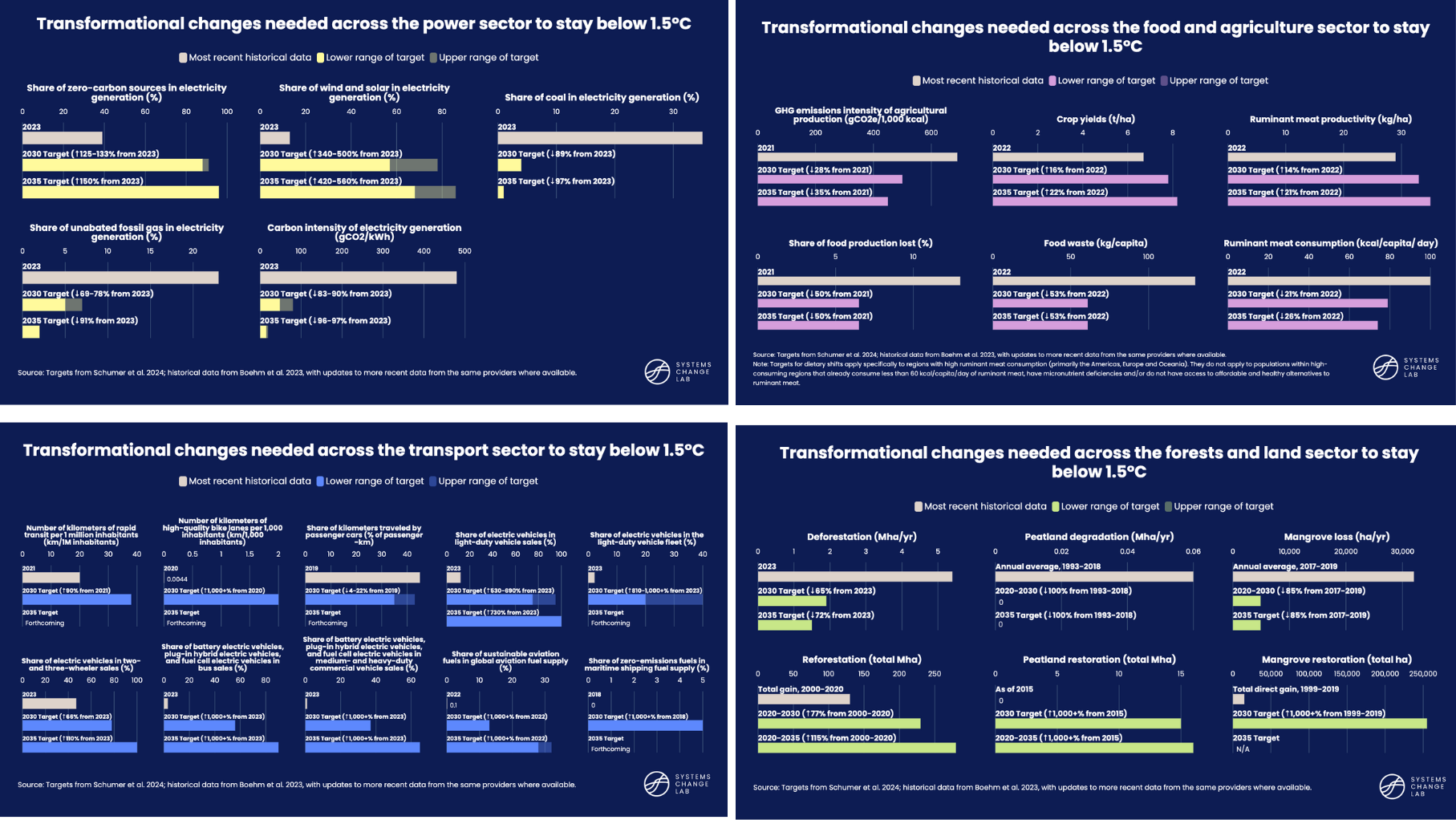
Four sets of data from Systems Change Lab on the most critical areas for climate action in the next ten years