



Our economic systems have exploited the global commons bringing them to breaking point. We need to radically transform these economic systems, which reward short term profits from commodity production based on unsustainable practices that deplete natural capital.
It is vital to enable and accelerate the changes needed that would reward investors and companies in safeguarding the global commons on which businesses, markets and societies depend. We’ve begun taking steps in this direction already so we can guide and support economic actors to play their part.
SCOUTING THE BEST PATHS FORWARD
Through Systems Change Lab, we partnered with the World Resources Institute’s (WRI) Global Economics Center to explore how the Global Commons Alliance can foster an economic system transformation through structural changes that accelerate safeguarding the global commons. We’re scouting out the best way to harmonize these efforts, together with partners such as WRI, Club of Rome, Capitals Coalition and others, to address the recognized need and desire for convergence.
At COP28, Systems Change Lab hosted a series of interactive workshops focused on unpacking connections within and surrounding the global food system. These highly engaging sessions encouraged participants to apply a systems lens to examine the complex interconnections involved in accelerating transformations.


Interactive workshops hosted by Systems Change Lab at COP28
The team also discussed the urgent need for the first Global Stocktake to serve as a springboard for accelerated actions to mitigate climate change at Turning the Global Stocktake into Action on the Ground and From Off Track to Achieving Systems Change: Action Needed by 2030 for 1.5 degrees C. Visit either link to watch a recording of the session.
TARGETS HAVING AN IMPACT
The Science Based Targets Network (SBTN) released its first iteration of the science-based targets for nature, for which the Safe and Just Framework was one of several key scientific inputs, just at the beginning of the financial year.
Seventeen pioneering companies including Carrefour, GlaxoSmithKline PLC, H&M Group, Holcim Group and Nestle began piloting these targets. These companies have contributed a wealth of data, totaling over 20,000 data points.
The pilot concluded in June 2024, and we’ve already gleaned five key insights from the pilot, including that:
- companies value the targets as a risk management tool to increase resilience
- companies acknowledge the pilot’s impact on their nature ambitions
- companies are already seeing measurable benefits.
Piloting science-based targets for nature has helped us identify areas where we can strengthen our existing climate focused initiatives, such as our forest positive and regenerative agriculture programs, to better respond to nature-related risks and opportunities across our value chain.”
Conor McMahon
Global Net Zero and Nature Lead, Nestle
160+
Companies now preparing to set targets
$4 trillion
In market capital
In June, 2024, SBTN announced that the Accountability Accelerator will host the validation of the new targets, a move welcomed by the community as a vital step in safeguarding the integrity of the targets.
In December 2023 SBTN announced plans to develop science-based targets for nature that include cities for the first time, alongside companies. The new program initially aims to create a holistic, science-based target indicators framework that covers the impact of cities on both climate and other natural systems and will result in preliminary guidance in 2025.
Working with cities and organizations around the globe, the new program is using indicators that include an equity aspect, and promote inclusion and diversity. Flexible targets are also being developed to align with cities’ different contexts, such as their unique capacities and responsibilities.
Regional hubs
To provide a support network to companies in key regions, and ensure the Science Based Targets Network’s methods are informed by a diverse range of perspectives including indigenous peoples, local communities and civil society groups, the Network has established regional working groups in Latin America, Southeast Asia, Australia and New Zealand and Japan with more coming soon.
NAVIGATIONAL SUPPORT
To support those working in companies and financial institutions with this work, the Accountability Accelerator, in partnership with the Climate Champions, released a new tool during COP28 to help navigate the complex landscape of climate and nature reporting frameworks.
During the COP, the Accountability Accelerator also hosted three important sessions bringing together over a hundred stakeholders – companies, financial institutions, and NGOs. These interactive sessions focused on the Nature and Climate Resource Navigator for companies and financial institutions, the accountability stakeholder interactive map and a meeting with standard and framework-setters to ensure better harmonization and alignment.
240k+
Social media impressions from the Navigator launch, across countries including the Global South. A majority of impressions (36.23% after the US's 50%) came from India
53
Climate and nature framework and tools included in the Navigator
HOLDING COMPANIES ACCOUNTABLE
While there are increasing numbers of frameworks, targets, and guidance aiming to enable companies and financial institutions to halt and reverse nature loss, these are not enough. We need to also enable and pressure businesses to act. A functioning accountability ecosystem drives action, is inclusive of all stakeholders and impacted communities, addresses inequality, and has consequences for inaction.
The Accountability Accelerator therefore supports, scales, and coordinates the efforts of accountability stakeholders through grants, convening and coordination, to strengthen this accountability ecosystem. A strong ecosystem requires frameworks and tools, education and capacity, new policies and regulation, assurance and pressures as well as community mobilization.
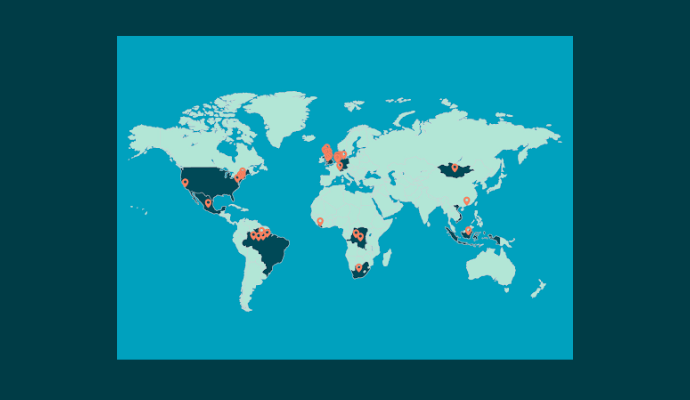
Locations around the world where Accountability Accelerator has allocated grants
Over the past year, the Accountability Accelerator has given forty grants to accelerate disclosure and action on climate and nature, support indigenous communities’ rights and empower young activists.
The supported organizations include groups working on creating guardrails for corporate directors, to those helping a local organization in Mongolia determine which laws can be used by local herders for environmental protection – including in a case against the World Bank Group, which invested in the enormous Oyu Tologi (OT) gold and copper mines – to an organization working on educating young influencers on the science behind science-based targets for companies so they can create data-driven campaigns globally.
By supporting the Accountability Counsel in Mongolia, the Accountability Accelerator’s grant continues to support local herders and other partners to press the OT Mine to fulfill its environmental commitments and address new issues connected to the mine’s expansion, with an emphasis on protecting water resources and ensuring sufficient access to safe water for all herders to continue their traditional livelihoods.Another of the grantee projects has brought crucial visibility to the cost of industrial cobalt mining in the DRC, showing how energy projects designed to stem the climate crisis have other implications on nature and people, which must also be considered in order for the clean energy transition to be fair. The CEO of GCAAA grantee RAID said that their ground-breaking report:
“Beneath the Green: A critical look at the cost of industrial cobalt mining in the DRC" was only possible with your (GCAAA) generous support and it marks not just the culmination of 19 months of dedicated research and rigorous analysis, but also a significant step forward in our shared mission to promote environmental stewardship and social responsibility.”
ENABLING FINANCE TO ACT
We’ve also worked, through the Accountability Accelerator with Global Canopy to support their Deforestation-free Finance Transition (DEFT) Pathway, which will provide financial institutions with a scalable and well-supported framework of clear, time-bound and practicable expectations for action by companies in their portfolios – helping to transition them more rapidly towards deforestation-free outcomes. It will define a rigorous multi-stage pathway on company progress toward eliminating deforestation, aligned with and backed by the Accountability Framework initiative. It will apply best-in-class data from across providers to categorize a large number of highly-exposed and/or widely financed companies into distinct stages. And it will support financial institutions to deliver clear, shared and time-bound expectations for companies in their portfolios to
companies to improve their performance. The DEFT Pathway is practical and actionable, co-designed with investors, and catalyzed by the Finance Sector Deforestation Action (FSDA) initiative with c. $9 trillion in assets under management.
EXPERT ANALYSES
Alongside providing tools and guidance for companies and financial institutions, and support to hold them accountable, we’ve also worked to keep decision makers informed through new research and data from Systems Change Lab, like their State of Climate Action 2023 report, which includes a comprehensive roadmap of how to close the global gap in climate action across sectors.
The report finds that recent progress toward 1.5°C-aligned targets isn’t happening at the pace and scale necessary and highlights where action must urgently accelerate this decade to reduce greenhouse gas emissions, scale up carbon removal and increase climate finance. The report findings were featured in top-tier media outlets including the Associated Press, Bloomberg, Fast Company, the Guardian, the New York Times, and the Washington Post, among others.
This year, Systems Change Lab also started a research series of deep-dive analyses examining countries that are leaders in transformational change. The first articles analyzed countries rapidly scaling up renewable power, accelerating electric vehicle adoption, and phasing out coal power. Many of these country case studies show bright spots that demonstrate rapid and exponential change is not only possible, but already taking off in some sectors and geographies.

Graphic from the State of Climate Action 2023 report
Mapping
To support more holistic action – beyond climate considerations – the Accountability Accelerator has undertaken a comprehensive mapping of the nature-focused corporate accountability ecosystem. The result is a global, interactive, visual mapping tool designed to bring transparency and connection to the accountability ecosystem, serving as a tool to inform stakeholder engagements, strategy and funding.
Prior to this exercise the community had no idea how many organizations were working on accountability, where the gaps and opportunities are, or how ‘accountability’ means different things to different people. The new mapping tool space allows for more effective funding, collaboration and breaking of silos, and the work is being expanded with a focus on the most important ecosystems on the planet: Amazonia, South Africa and the Congo, and SouthEast Asia.




Demonstrate
To upscaleIn February 2024, and following the Earth Commission's major science launch, the Global Commons Alliance convened a group of Nordic cities to understand what it means for cities to live within the Safe and Just Earth System Boundaries.